
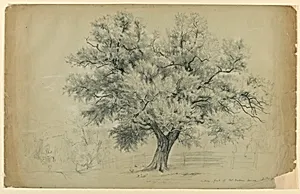
Study of a Willow, North Conway, New Hampshire
Classification
nature studies
Department
Smithsonian Collection
Museum
Smithsonian American Art Museum
Credit
Bequest of Erskine Hewitt
Accession Number
1942-50-23
Rights
Public Domain
About this artwork
Research in Progress
Art Historical Context
In the mid-1850, American artist Daniel Huntington1816–1906 created this intimate nature study of a willow tree North Conway, New Hampshire. Huntington was a leading figure in 19th-century American, celebrated especially for portraits and historical subjects, yet works like this reveal his close attention to the natural world. Classified as a nature study, the piece captures the distinctive form and texture of the willow, reflecting the period’s growing interest in documenting America’s landscapes with care and precision. North Conway, in the scenic White Mountains, attracted many artists of the era who sketched directly from nature. Dated 1855–56, this study belongs to that tradition of on-site observation, in which artists recorded specific trees, rocks, and foliage as references or independent works. Though the exact medium is not recorded, such studies typically served both as artistic exercises and as records of a rapidly changing landscape. Bequeathed to the Smithsonian American Art Museum by Erskine Hewitt, the drawing invites viewers to appreciate Huntington’s versatility and the quiet beauty he found in a single tree. It offers a window onto mid-19th-century artistic practice and the enduring American fascination with the natural environment.