
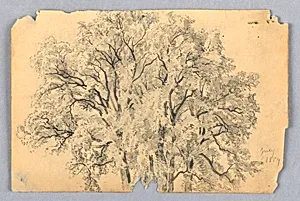
Study of elm tree
Medium
nature studies
Classification
nature studies
Department
Smithsonian Collection
Museum
Smithsonian American Art Museum
Credit
Gift of the National Academy of Design from the Mrs. William T. Brewster Bequest
Accession Number
1953-179-5
Rights
Public Domain
About this artwork
Research in Progress
Art Historical Context
William Trost Richards, a pioneering American artist born in 1833, created *Study of Elm Tree* in July 1854, early in his career when he was just 21. This delicate nature study exemplifies the meticulous observation of the natural world that would define his lifelong passion for landscape painting. Associated with the Hudson River School and later influenced by Pre-Raphaelite precision, Richards honed his skills through such sketches, capturing the organic forms of trees with remarkable fidelity. As a preparatory work in pencil or similar medium, this piece reflects mid-19th-century artistic training, where close studies of flora served as foundational exercises for grander compositions. Elm trees, iconic in American landscapes, symbolized enduring natural beauty amid rapid industrialization. Richards's attention to bark texture, branching patterns, and foliage underscores his commitment to truthful representation, bridging Romanticism's awe of nature with emerging scientific realism. Housed in the Smithsonian American Art Museum's Smithsonian Collection, this study was generously gifted by the National Academy of Design through the Mrs. William T. Brewster Bequest. It invites visitors to appreciate the quiet artistry behind iconic vistas, reminding us how intimate sketches fueled America's golden age of landscape art.