
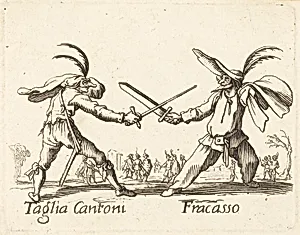
Taglia Cantoni and Fracasso
1622 or later
Medium
etching on laid paper
Dimensions
plate: 7.3 × 9.4 cm (2 7/8 × 3 11/16 in.) sheet: 7.7 × 10.4 cm (3 1/16 × 4 1/8 in.)
Classification
Department
CG-E
Museum
National Gallery of Art, Washington, D.C.
Credit
Rosenwald Collection
Accession Number
1943.3.2185
Rights
Public Domain
Art Historical Context
Discover the whimsical world of commedia dell'arte in *Taglia Cantoni and Fracasso*, an etching after the masterful Jacques Callot, created in 1622 or later. Thisutive print (plate: 7.3 × 9.4 cm) captures two lively characters—Taglia Cantoni a sharp-tongued zanni, and the boastful Capitano Fracasso—fromot's renowned *Balli di Sfessania*. These fantastical dancers, adorned in exaggerated costumes, embody the grotesque humor and athleticism of early 17th-century Italian theatrical spectacles performed at the Medici court in Florence, where Callot worked. Callot, a pioneering Baroque printmaker (1592–1635), revolutionized etching with his intricate line work and ability to convey motion in tiny formats. Working "after" him means this piece faithfully reproduces his original technique on laid paper, using acid to etch fine details into a metal plate for multiple impressions. Such small-scale prints democratized art, making high-quality imagery accessible beyond elite patrons. Housed in the National Gallery of Art's Rosenwald Collection, this etching highlights Callot's enduring influence on graphic arts and popular culture, blending satire, dance, and Baroque exuberance into a pocket-sized treasure for enthusiasts of print history.
About the Artist
after Jacques Callot
**Jacques Callot (c. 1592–1635)**, the master whose designs inspired the works attributed "after Jacques Callot," was a pioneering French Baroque printmaker and draftsman born in Nancy, capital of the independent Duchy of Lorraine (now northeastern France). From a noble family—his father served as master of ceremonies and herald-at-arms to the Duke of Lorraine—young Callot was apprenticed to a gol...