
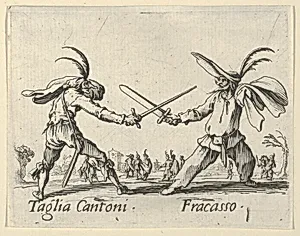
Taglia Cantoni - Fracasso, from the Balli di Sfessania
ca. 1622
Medium
Etching
Dimensions
Sheet: 2 15/16 × 3 3/4 in. (7.5 × 9.6 cm)
Classification
Prints
Department
Drawings and Prints
Museum
Metropolitan Museum of Art, New York, NY
Credit
Bequest of Edwin De T. Bechtel, 1957
Accession Number
57.650.304(14)
Rights
Public Domain
Tags
Art Historical Context
Jacques Callot's *Taglia Cantoni - Frasso, from the Balli diessania* (ca. 1622) is a captivating etching from a renowned series of 18 prints depicting the wild, grotesque dances of Italian commedia dell'arte performers. This tiny work (just under 3 by 4 inches) captures two male figures—likely the buffoonish Sfessania characters Taglia Cantoni and Frasso—in a dynamic clash with swords, blending slapstick combat and theatrical flair. Callot, a masterful French etcher active in Italy, immortalized these lively entertainments that thrilled 17th-century audiences across Europe. Etching allowed Callot to achieve extraordinary detail and expressive linework in such a compact format, making his prints affordable and widely circulated. The *Balli di Sfessania* series exemplifies his Baroque style: exaggerated poses, intricate costumes, and a sense of chaotic energy that satirizes human folly. Commedia dell'arte, with its masked stock characters and improvised antics, was a cornerstone of popular culture, influencing theater, dance, and visual arts from Italy to France. Housed in the Metropolitan Museum of Art's Drawings and Prints department, this piece highlights Callot's innovative techniques and enduring appeal, offering visitors a window into the exuberant street performances that defined Renaissance-era leisure.
About the Artist
Jacques Callot · 1592–1635
Jacques Callot (1592–1635) was a French printmaker and draftsman from the Duchy of Lorraine, widely regarded as one of the first great artists to practice the graphic arts exclusively. His more than 1,400 etchings chronicled the breadth of 17th-century life, from Medici court festivities to the brutal realities of warfare. Callot revolutionized etching through technical innovations including the é...