
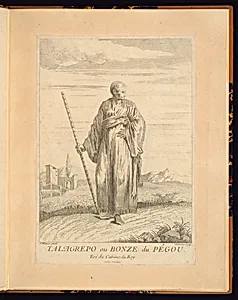
Talagrepo ou Bonze du Pégou
Medium
Classification
Department
Smithsonian Collection
Museum
Smithsonian American Art Museum
Credit
Purchased for the Museum by the Advisory Council
Accession Number
1921-6-495-9
Rights
Public Domain
About this artwork
Research in Progress
Art Historical Context
Antoine Watteau, the celebrated French Rococo master (4–1721), is best known for his enchanting *fêtes galantes*—elegant outdoor scenes of lovers and revelers. Yet this print, *Talag ou Bonze du Pégou* (dated 1731, a decade after his death), reveals his fascination with exotic characters. Likely an engraving after one of Watteau's figure studies, it depicts a "bonze" (Buddhist monk) from Pégou, an ancient name for Bago in Myanmar, capturing the artist's skill in rendering expressive poses and intricate costumes. Produced as a print, the work exemplifies the era's booming printmaking culture, which democratized art by reproducing drawings for a wider audience. Watteau's fluid lines and delicate shading translate beautifully to this medium, showcasing his draftsmanship's poetic grace. Posthumous editions like this one sustained his influence during the Rococo period, blending European fantasy with early Orientalist curiosity. Housed in the Smithsonian American Art Museum's collection (purchased by the Advisory Council), *Talagrepo* invites visitors to ponder Watteau's versatility beyond pastoral idylls. Research continues, but it stands as a gem highlighting 18th-century Europe's growing intrigue with distant cultures. (198 words)