
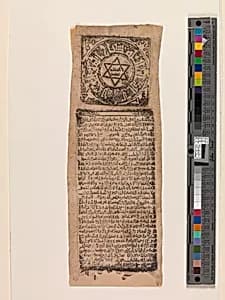
Talismanic Scroll
Unknown Artist
11th century
Medium
Ink on paper; block-printed
Dimensions
H. 9 1/16 in. (23 cm) W. 3 5/16 in. (8.4 cm)
Classification
Codices
Department
Islamic Art
Museum
Metropolitan Museum of Art, New York, NY
Credit
Gift of Nelly, Violet and Elie Abemayor, in memory of Michel Abemayor, 1978
Accession Number
1978.546.32
Rights
Public Domain
Art Historical Context
Nestled in the Islamic Art collection of the Metropolitan Museum of, this *Talismanic Scroll* from the 11th century is a captivating example of medieval protective artistry. Crafted by an unknown artist using ink on paper via block-printing—a pioneering technique in the Islamic world—this slender scroll measures just 9 1/16 inches high and 3 5/16 inches wide, designed for portability. Likely rolled and carried as a personal amulet, it exemplifies the codex tradition adapted into compact, magical formats. In the vibrant cultural landscape of 11th-century Islam, under dynasties like the Fatimids or Seljuks, talismans like this one held profound spiritual power. Adorned with intricate inscriptions—possibly Quranic verses, prayers, or mystical symbols—they were believed to ward off evil, illness, or misfortune. Block-printing, involving carved wooden blocks inked and pressed onto paper, allowed for efficient production of these sacred texts, bridging calligraphy and early printing innovations long before Gutenberg. This rare survivor, gifted in 1978 in memory of Michel Abemayor, invites us to ponder the blend of faith, artistry, and everyday devotion in medieval Muslim life. Its delicate preservation highlights the enduring allure of Islamic esoteric traditions.