
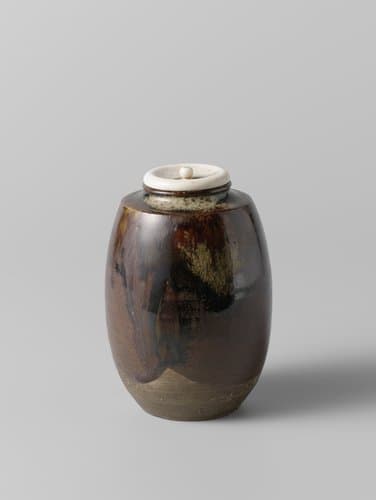
Tea caddy with a brown glaze
c. 1700 - c. 1799
Medium
turning
Dimensions
1.5; 9.9; 7.2; 4.2; 3.6; 3.7; 10.5
Rights
Public Domain
About this artwork
Stoftheebus of chaire van steengoed met een ivoren deksel, gedeeltelijk bedekt met een bruin glazuur. Het onderste deel van de bus is ongeglazuurd. Oud label aan de binnenzijde met 'Agano/ 18e?'. Agano.
Art Historical Context
This elegant tea caddy, known as a *chaire* in Japanese tea ceremony tradition, dates to the 18th century (c. 1700–1799) and stands just 10.5 cm tall. Crafted anonymously from stoneware (*steengoed*) using turning techniques on a lathe, it features a partial brown glaze that lends a warm, earthy tone, while the lower portion remains unglazed for a tactile, natural contrast. Crowned with an ivory lid it once held powdered green tea (*matcha*), essential for *chanoyu* rituals. An old interior label reading "Agano/18e?" identifies its origin from the Agano kilns, renowned for such functional yet refined ceramics. Agano ware emerged in Japan's Saga Prefecture during the Edo period, a time when tea culture flourished among samurai and merchants. These caddies were prized for their understated beauty, embodying *wabi-sabi*—the aesthetic of imperfection and transience. The brown glaze and unglazed base mimic earlier, revered styles like Raku ware, blending utility with subtle artistry. As a museum highlight, this piece offers a window into 18th-century Japanese craftsmanship, where form followed the meditative flow of tea preparation. Its compact form and mixed materials underscore the era's innovative pottery techniques, making it a quiet testament to cultural devotion.