
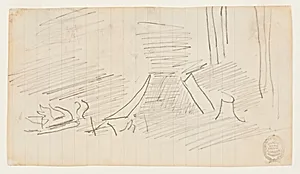
Tent and Campfire
Medium
landscapes
Classification
landscapes
Department
Smithsonian Collection
Museum
Smithsonian American Art Museum
Credit
Gift of Charles Savage Homer, Jr.
Accession Number
1912-12-232
Rights
Public Domain
About this artwork
Research in Progress
Art Historical Context
Winslow Homer's *Tent and Campfire*1895–97) captures the rugged allure of the American wilderness during the artist's later years. A master of Realism, Homer, an American painter born in 1836 and active until 1910, from Civil War scenes and coastal marines to intimate landscapes, often rendered in watercolor or oil. This work, classified as a landscape from the Smithsonian American Art Museum collection (gift of Charles Savage Homer Jr.), evokes the era's growing fascination with outdoor recreation and escape from industrialization. Created amid Homer's retreats to Maine and the Adirondacks, the painting reflects late 19th-century Romanticism in American art—celebrating nature's solitude and raw beauty. Homer's technique emphasized dramatic light effects, bold compositions, and a keen observation of atmosphere, making everyday scenes like a tent and flickering campfire pulse with life and emotion. It speaks to cultural shifts toward camping as leisure, popularized by figures like Theodore Roosevelt. Housed in the Smithsonian's landscape department, *Tent and Campfire* invites visitors to ponder humanity's harmony (or tension) with the wild, a timeless Homer hallmark. (178 words)