
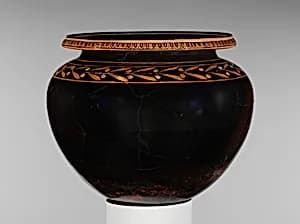
Terracotta lebes (deep bowl)
Unknown Artist
ca. 450–425 BCE
Medium
Terracotta
Dimensions
H. 10 1/2 in. (26.7 cm) diameter 9 1/2 in. (24.1 cm)
Classification
Vases
Culture & Period
Greek, Attic · Classical
Department
Greek and Roman Art
Museum
Metropolitan Museum of Art, New York, NY
Credit
Rogers Fund, 1907
Accession Number
07.286.71
Rights
Public Domain
Art Historical Context
Step into the vibrant world of Classical Athens with this elegant terracotta lebes, deep bowl dating to around 450–425 BCE. Crafted by an unknown Attic potter, exemplifies the refined pottery of ancient Greece during its Classical period—a golden age of democracy, philosophy, and artistic excellence. Standing at 10½ inches tall with a 9½-inch diameter, this compact yet sturdy vessel was likely used for mixing water and wine, bathing rituals, or even as a bridal offering, highlighting the seamless blend of utility and beauty in everyday Greek life. Attic terracotta vases like this one were fired in kilns to achieve their warm, reddish hue, showcasing masterful wheel-throwing techniques that produced perfectly balanced forms. The lebes shape, with its wide mouth and deep basin, was a staple in households and sanctuaries, often elevated on a stand for ceremonial display. Though decoration details are not preserved here, such pieces typically featured black- or red-figure painting with mythological scenes, reflecting the Greeks' love for storytelling through art. Acquired through the Rogers Fund in 1907, this treasure from the Metropolitan Museum of Art's Greek and Roman collection invites us to ponder the anonymous hands that shaped it—hands that contributed to one of antiquity's most influential ceramic traditions, influencing art across the Mediterranean.