
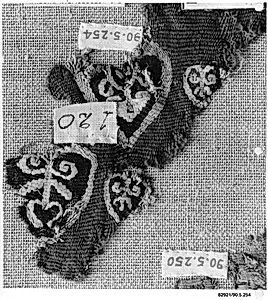
Textile Fragment
Unknown Artist
5th–6th century
Medium
Wool, linen; plain weave, tapestry weave
Dimensions
Max. L. 5 3/8 in. (13.6 cm) Max. W. 1 15/16 in. (5 cm)
Classification
Textiles
Department
Islamic Art
Museum
Metropolitan Museum of Art, New York, NY
Credit
Gift of George F. Baker, 1890
Accession Number
90.5.254
Rights
Public Domain
Art Historical Context
This delicate Textile Fragment, dating to the 5th–6th century offers a glimpse into the sophisticated textile traditions of the early medieval Near East or North Africa, now housed in the Metropolitan Museum of Art's Islamic Department. Crafted from wool and linen, it the era's blend of everyday durability and artistic ambition, likely originating from a garment, furnishing, or ritual cloth in a region bridging Late Antiquity and emerging Islamic cultures. The fragment showcases two key weaving techniques: weave for its sturdy, foundational structure, and tapestry weave for vibrant, pictorial inserts. Tapestry weave, where colored weft threads are woven over foundation warps to create patterns, allowed artisans to produce intricate motifs without dyes bleeding— a labor-intensive method highlighting skilled craftsmanship in pre-industrial workshops. Though small (just 5 3/8 by 1 15/16 inches), this survivor speaks to the cultural importance of textiles as portable wealth and storytelling mediums. Donated in 1890 by George F. Baker, it reminds us how fragments preserve the tactile artistry of vanished worlds, inviting us to imagine the hands that wove it centuries ago.