
Textile
1880
Medium
printed, dyed & painted textiles
Classification
printed, dyed & painted textiles
Department
Smithsonian Collection
Museum
Smithsonian American Art Museum
Credit
American Textile History Museum Collection, gift of Katharine Kreiser and Arthur Larson
Accession Number
2016-35-77
Rights
Public Domain
About this artwork
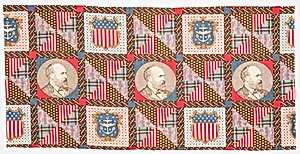
Printed patchwork fragment has the image of President James A. Garfield and alternating shield flags patterned with either stars and stripes or an anchor with stars. Remaining quadrants have a printed patchwork design and are divided into eight equal triangles filled with four different patterns. This particular image of Garfield in profile wearing a white shirt and dark jacket and tie is based on a photograph from the Pach Brothers photography studio of New York and was widely circulated around...
Art Historical Context
This vibrant textile fragment from 1880 captures the fervor surrounding James A. Garfield's presidential campaign. Centered is a profile portrait of Garfield, dressed in a white shirt, dark jacket, and tie, derived from a widely circulated photograph by New York’s Pach Brothers studio. Surrounding the image are alternating shield-shaped flags—one patterned with stars and stripes, the other featuring an anchor amid stars—evoking patriotic pride. The remaining quadrants form a printed patchwork design, cleverly divided into eight equal triangles filled with four distinct patterns, blending folk art aesthetics with commercial printing techniques. Created using printed, dyed, and painted methods on fabric, this piece exemplifies 19th-century American textile production, where everyday materials became vehicles for political memorabilia. Garfield, elected as the 20th U.S. President in 1880, was assassinated just months after taking office in 1881, making such artifacts poignant relics of a brief era. Donated to the Smithsonian American Art Museum from the American Textile History Museum Collection (gift of Katharine Kreiser and Arthur Larson), it highlights how textiles democratized celebrity and nationalism, adorning homes during pivotal election seasons. Today, this fragment invites reflection on how visual culture shaped public devotion to leaders, transforming a simple photograph into a tactile symbol of American identity.