
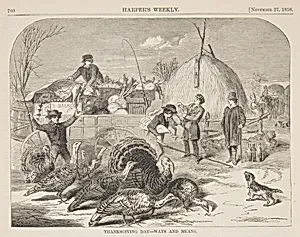
Thanksgiving Day – Ways and Means
November 27, 1858
Medium
figures
Classification
figures
Department
Smithsonian Collection
Museum
Smithsonian American Art Museum
Credit
Gift of John Goldsmith Phillips, Jr.
Accession Number
1947-4-37
Rights
Public Domain
About this artwork
Research in Progress
Art Historical Context
**Thanksgiving Day – Ways and Means** *Winslow Homer, American, 1836–1910, November 27, 1858* Winslow Homer's *Thanksgiving Day – Ways and Means*, created in 1858, offers a glimpse into early American holiday life during the artist's formative years as an illustrator. At just 22, Homer was honing his craft for popular magazines, capturing the vibrancy of everyday scenes with a fresh, observant eye. This work, dated to late November—a prime time for Thanksgiving imagery—likely evokes the resourcefulness and communal spirit of the era, when families gathered for feasts amid the challenges of antebellum America. Classified as a depiction of figures and housed in the Smithsonian American Art Museum's collection (gift of John Goldsmith Phillips, Jr.), the piece highlights Homer's emerging talent for portraying human activity. His early style, rooted in precise line work suited to print media, laid the groundwork for his later Realist masterpieces, emphasizing authentic American experiences over idealization. Though research continues, it reflects cultural traditions of gratitude and ingenuity that defined 19th-century Thanksgivings. This modest yet evocative artwork reminds us of Homer's roots in illustration, bridging popular culture and fine art for generations of viewers.