
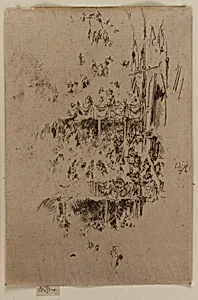
The Abbey Jubilee
Classification
Department
Smithsonian Collection
Museum
Smithsonian American Art Museum
Credit
Gift of Charles Lang Freer
Accession Number
F1903.29
Rights
Public Domain
Tags
About this artwork
2
Art Historical Context
James McNeill Whistler’s 1887 print *The Abbey Jubilee* captures a moment of architectural grandeur tied to Queen Victoria’s Golden Jubilee celebrations. As an American expatriate working primarily in Britain, Whistler brought his distinctive sensibility to the etching medium, transforming a historic site—likely Westminster Abbey—into a delicate study of light, line, and atmosphere. The work reflects his lifelong fascination with urban landmarks and the subtle moods they evoke. Classified as a print and created through the etching process, this piece highlights Whistler’s technical mastery. He often reworked plates to achieve tonal richness and spatial depth, moving beyond mere documentation to suggest the quiet presence of centuries-old stone. The Smithsonian American Art Museum’s impression was gifted by Charles Lang Freer, whose renowned collection helped preserve many of Whistler’s works for American audiences. Today the print offers visitors a window into late-Victorian Britain through the eyes of one of the era’s most influential artists. Its restrained elegance and architectural focus underscore Whistler’s belief that art should evoke rather than describe, inviting viewers to linger over the interplay of history and fleeting impression.