
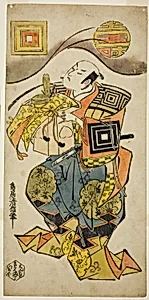
The Actor Ichikawa Danjuro II as Soga no Juro in the play "Hanabusa Bunshin Soga," performed at the Ichimura Theater in the first month, 1733 (?)
c. 1733
Medium
Hand-colored woodblock print; hosoban, urushi-e
Dimensions
33 × 16.2 cm (13 × 6 7/16 in.)
Classification
woodblock print
Department
Arts of Asia
Museum
Art Institute of Chicago
Accession Number
36197
Rights
Public Domain
Art Historical Context
This striking woodblock print captures the celebrated kabuki actor Ichikawa Danjuro II in the role of Soga no Juro, one of the heroic brothers in the classic revenge tale “Hanabusa Bunshin Soga.” Created around 1733 by Torii Kiyonobu II, a leading figure in the Torii school of ukiyo-e, the work commemorates a performance at Edo’s Ichimura Theater. Actor prints like this one served as vibrant souvenirs for theatergoers, preserving the dynamic poses and costumes of live performances in a medium accessible to a broad audience. Measuring just 33 by 16.2 centimeters, the narrow hosoban format was ideal for posting or carrying home. The print belongs to the early urushi-e (“lacquer picture”) style, in which bold black outlines were hand-colored and enhanced with glossy ink that mimicked the sheen of lacquer. These techniques allowed artists to convey movement and theatrical intensity even within the constraints of early woodblock technology. As one of the earliest surviving examples of kabuki actor portraiture, the sheet offers a vivid glimpse into eighteenth-century Japanese popular culture, where stage drama and visual art intertwined to shape public imagination. Today it resides in the Art Institute of Chicago’s collection of Asian art, inviting modern viewers to appreciate both the artistry and the lively world of Edo-period theater.
About the Artist
Torii Kiyonobu II · 1702–1752
Japanese, ca. 1702–1752