
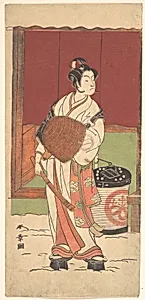
The Actor Ichikawa Monosuke II in the Role of Daito-no-miya Disguised as a Komuso
ca. 1772 (?)
Medium
Woodblock print (nishiki-e); ink and color on paper
Dimensions
12 x 5 3/4 in. (30.5 x 14.6 cm)
Classification
Prints
Culture & Period
Japan · Edo period (1615–1868)
Department
Asian Art
Museum
Metropolitan Museum of Art, New York, NY
Credit
The Howard Mansfield Collection, Purchase, Rogers Fund, 1936
Accession Number
JP2705
Rights
Public Domain
Tags
Art Historical Context
In the vibrant world of Edo-period Japan (1615–1868 Katsukawa Shunshō (1726–1792) captures the dramatic flair of kabuki theater in this woodblock print, *The Actor Ichikawa Monos II in the Role ofaito-no-miya Disised as a Komuso*, dated around 1772. Shunshō, a leading figure in the ukiyo-e traditionliterally "pictures of the floating world"—specialized in yakusha-e, or actor portraits, that brought the stage's energy to everyday viewers. Here, the famed actor Ichikawa Monosuke II embodies a noble figure from a kabuki play, disguised as a komusō, a wandering monk known for his distinctive basket-like tengai hat and flute-playing, adding layers of intrigue and disguise central to the genre. This nishiki-e, or "brocade picture," exemplifies the revolutionary multi-color woodblock printing technique perfected in the 1760s, using intricate carved blocks for vivid inks layered on paper to mimic luxurious textiles. Measuring just 12 x 5¾ inches, its intimate scale suited urban collectors in Edo (modern Tokyo), where kabuki stars were celebrities. Shunshō's realistic style, with expressive poses and dynamic lines, influenced generations, bridging theater and fine art. Housed in the Metropolitan Museum of Art from The Howard Mansfield Collection, this print offers a window into Japan's playful yet sophisticated popular culture, where art celebrated impermanence and performance. Visitors, imagine the roar of the crowd as Monosuke II strides onstage—Shunshō freezes that thrill forever.
About the Artist
Katsukawa Shunshō 勝川春章 (Japanese) · 1726 –1792
Japanese, 1726–1792