
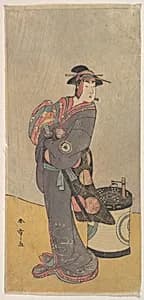
The Fourth Iwai Hanshiro as an Onnadate (Woman Kyokaku)
ca. 1787–90
Medium
Woodblock print (nishiki-e); ink and color on paper
Dimensions
12 x 5 5/8 in. (30.5 x 14.3 cm)
Classification
Prints
Culture & Period
Japan · Edo period (1615–1868)
Department
Asian Art
Museum
Metropolitan Museum of Art, New York, NY
Credit
Purchase, Joseph Pulitzer Bequest, 1918
Accession Number
JP380
Rights
Public Domain
Tags
Art Historical Context
This captivating woodblock print by Katsukawa Shunshō captures Iwai Hanshirō IV, a celebrated kabuki actor of the late eighteenth century, in the role of an onnadate—a spirited female gallant or “woman knight” who embodied courage and independence. Created around 1787–90 during Japan’s Edo period, the work reflects the vibrant theater culture of the time, when actors were treated like modern celebrities and their performances inspired countless souvenirs for devoted fans. Shunshō, a leading figure in the Katsukawa school, specialized in actor portraits that conveyed both likeness and dramatic presence. Printed in the innovative nishiki-e (“brocade picture”) technique, the image uses multiple carved blocks to layer rich inks and colors on paper, allowing for subtle gradations and expressive details in costume and pose. At just over twelve inches tall, the narrow format was typical of the period’s actor prints, designed to be collected, displayed, or even pasted into albums. The Metropolitan Museum’s impression, acquired in 1918, preserves the delicate lines and hues that once brought the excitement of the kabuki stage into everyday Edo homes. Beyond its visual charm, the print offers a window into shifting gender roles and popular entertainment in pre-modern Japan, where onnadate characters let audiences explore themes of bravery and defiance through the artistry of both performer and printmaker.
About the Artist
Katsukawa Shunshō 勝川春章 (Japanese) · 1726 –1792
Japanese, 1726–1792