
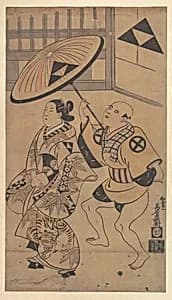
The Actor Ikushima Daikichi as an Oiran on Parade in the Streets of the Yoshiwara
ca. 1701–06
Medium
Woodblock print; ink and color on paper
Dimensions
20 31/32 x 11 7/8 in. (53.3 x 30.2 cm)
Classification
Prints
Culture & Period
Japan · Edo period (1615–1868)
Department
Asian Art
Museum
Metropolitan Museum of Art, New York, NY
Credit
The Francis Lathrop Collection, Purchase, Frederick C. Hewitt Fund, 1911
Accession Number
JP648
Rights
Public Domain
Tags
Art Historical Context
In the vibrant Yoshiwara pleasure district of Edo (modern Tokyo), during Japan's Edo period (16151868), high-ranking courtesans known as *oiran* paraded through the streets in elaborate process, captivating crowds with their towering hairstyles, ornate kimonos, and graceful movements. This woodblock print by Torii Kiyonobu (active ca. 1696–1721), dated around 1701–06, captures kabuki actor Ikushima Daichi in just such a role. Kiyonobu, a founder of the Torii school, specialized in *yakusha-e*—actor portraits that brought the theater world to life for everyday viewers. Printed with ink and color on paper, this *ukiyo-e* ("pictures of the floating world") exemplifies early techniques of the genre: bold outlines, flat colors, and dynamic poses that emphasize performance over realism. At 20 31/32 x 11 7/8 inches, it was designed for affordable display in homes, democratizing art amid kabuki's rising popularity. Actors like Daikichi, playing female roles as *onnagata*, blurred gender lines, reflecting Edo society's fascination with beauty, transience, and entertainment. Held in the Metropolitan Museum of Art's Asian Art collection, this print highlights how ukiyo-e preserved fleeting moments of urban culture, influencing global art from Hokusai to Impressionism. Imagine the buzz of Yoshiwara's streets alive in your living room!
About the Artist
Torii Kiyonobu I · 1664–1729
Torii Kiyonobu I (1664–1729), born Shōbei in Osaka, was the second son of Torii Kiyomoto, a prominent kabuki actor specializing in onnagata roles and a painter of theater signboards. He studied painting under his father as well as Yoshida Hanbei and Hishikawa Moronobu, the pioneering ukiyo-e master whose figure styles profoundly shaped his early work. In 1687, at age twenty-four, Kiyonobu accompan...