
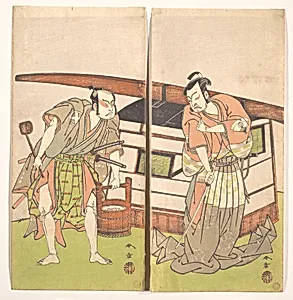
The Actor Otani Hiroji III and the Actor Onoe Kikugoro I
ca. 1778
Medium
Diptych of woodblock prints (nishiki-e); ink and color on paper
Dimensions
A: H. 12 in. (30 cm); W. 5 5/8 in. (14.3 cm) B: H. 11 15/16 in. (30.3 cm); W. 5 5/8 in. (14.3 cm)
Classification
Prints
Culture & Period
Japan · Edo period (1615–1868)
Department
Asian Art
Museum
Metropolitan Museum of Art, New York, NY
Credit
Purchase, Joseph Pulitzer Bequest, 1918
Accession Number
JP400a, b
Rights
Public Domain
Tags
Art Historical Context
Step into the vibrant world of Edo-period Japan with Katsukawa Shunshō'sThe Actor Otani Hiroji III and the Actore Kikugoro I* (ca. 1778), a stunning diptych of woodblock prints from the Museum of Art. Shunshō, a master the Katsukawa school and pioneer in ukiyo-e ("pictures of the floating world"), two legendary Kabuki actors in dynamic poses, likely mid-performance with swords at the ready. This intimate-scale work—each panel about 12 inches tall—pairs Otani Hiroji III and Onoe Kikugoro I, stars of the theater scene whose images fueled fan frenzy among commoners. Crafted as nishiki-e, or "brocade pictures," these ink and color prints on paper showcase Shunshō's innovative use of multiple woodblocks for layered, jewel-like hues—a technical leap in 18th-century printing that made art accessible and affordable. During the Edo period (1615–1868), such yakusha-e (actor prints) democratized Kabuki culture, turning performers into celebrities and blurring lines between stage and street life. Admire the meticulous details: flowing robes, expressive faces, and gleaming swords that evoke the drama of aragoto (rough stuff) roles. Acquired through the Joseph Pulitzer Bequest in 1918, this diptych invites you to feel the pulse of Japan's theatrical golden age.
About the Artist
Katsukawa Shunshō 勝川春章 (Japanese) · 1726 –1792
Japanese, 1726–1792