
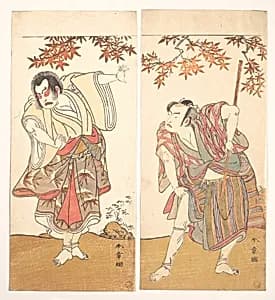
The Actors Ichimura Uzaemon and Arashi Sangorō
ca. 1773
Medium
Diptych of woodblock prints (nishiki-e); ink and color on paper
Dimensions
Overall: H. 12 5/16 in. (31.3 cm); W. 11 in. (27.9 cm)
Classification
Prints
Culture & Period
Japan · Edo period (1615–1868)
Department
Asian Art
Museum
Metropolitan Museum of Art, New York, NY
Credit
Purchase, Joseph Pulitzer Bequest, 1918
Accession Number
JP401a, b
Rights
Public Domain
Tags
Art Historical Context
Step into the lively world of Edo-period Japan with Katsukawa Shunshō's *The Actors Ichimura Uzaemon and Arashi Sangorō* (ca. 1773), a captivating diptych of woodblock prints from thekiyo-e tradition—"pictures of the floating world" that celebrated everyday pleasures like kabuki theater. Shunshō, a leading figure in the Katsukawa school, was renowned for his yakusha-e (actor prints), which immortalized star performers in dramatic poses. Here, the famed actors Ichimura Uzaemon and Arashi Sangorō are portrayed with vivid energy, evoking the thrill of Tokyo's bustling playhouses during the genre's golden age (1615–1868). Crafted as nishiki-e, or "brocade pictures," this ink and color on paper work showcases the innovative multi-block printing technique that allowed for rich, layered hues rivaling textiles. Measuring about 12 inches high, the diptych joins two sheets into a harmonious whole, highlighting intricate details like flowing robes, expressive faces, and motifs such as leaves—likely props or scenic elements from a kabuki scene. Shunshō's mastery lies in his realistic yet stylized depictions, blending portraiture with theatrical flair to capture the actors' charisma. Housed in the Metropolitan Museum of Art's Asian Art Department (purchased via the Joseph Pulitzer Bequest in 1918), this print reflects kabuki's cultural dominance, where actors were celebrities akin to modern idols. It invites us to appreciate how ukiyo-e democratized art, making high drama accessible to all.
About the Artist
Katsukawa Shunshō 勝川春章 (Japanese) · 1726 –1792
Japanese, 1726–1792