
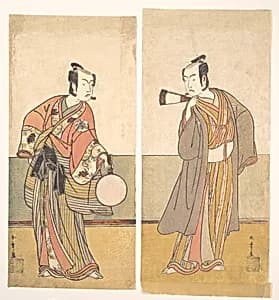
The Actors the Fourth Matsumoto Koshiro and the Arashi Sangoro
Medium
Diptych of woodblock prints (nishiki-e); ink and color on paper
Dimensions
H. 12 1/4 in. (31.1 cm); W. 11 1/2 in. (29.2 cm)
Classification
Prints
Culture & Period
Japan · Edo period (1615–1868)
Department
Asian Art
Museum
Metropolitan Museum of Art, New York, NY
Credit
Purchase, Joseph Pulitzer Bequest, 1918
Accession Number
JP390a, b
Rights
Public Domain
Tags
Art Historical Context
Created in 1776 during Japan’s Edo period, this diptych by Katsukawa Shunshō captures two celebrated kabuki actors: Matsumoto Kōshirō IV and Arashi Sangorō. Shunshō, a leading figure of the Katsukawa school, specialized in yakusha-e—actor portraits that brought the excitement of the theater to a wider audience. His works often emphasized individual likenesses and expressive poses, helping to elevate actor prints from simple souvenirs to respected art forms. Printed as a nishiki-e diptych using multiple carved blocks for vivid colors, the piece reflects the technical sophistication of ukiyo-e woodblock printing at its peak. Such prints were immensely popular among Edo townspeople, who followed star actors much like modern celebrities. By pairing two figures across separate sheets, Shunshō created a dynamic composition that invited viewers to imagine the actors interacting on stage. Today housed in the Metropolitan Museum of Art, this work offers a vivid glimpse into eighteenth-century Japanese theater culture and the artistry that made ukiyo-e prints a lasting global phenomenon.
About the Artist
Katsukawa Shunshō 勝川春章 (Japanese) · 1726 –1792
Japanese, 1726–1792