
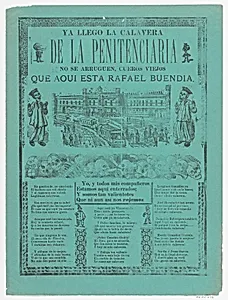
The arrival of the skeletons of the penitentiary (Posada); two skeleton angels in lower corners of verso (Manilla)
Medium
Zincograph and letterpress on green paper
Dimensions
Sheet: 15 3/4 × 11 13/16 in. (40 × 30 cm)
Classification
Prints
Department
Drawings and Prints
Museum
Metropolitan Museum of Art, New York, NY
Credit
The Elisha Whittelsey Collection, The Elisha Whittelsey Fund, 1946
Accession Number
46.46.278
Rights
Public Domain
Tags
Art Historical Context
Created in 1902 by the collaborative team of Manuel Manilla, José Guadalupe Posada, and publisher Antonio Vanegas Arroyo, this zincograph and letterpress print on green paper exemplifies the vibrant tradition of Mexican popular graphics. Measuring roughly 16 by 12 inches, the sheet was designed as an affordable broadside, combining bold imagery with text to reach wide audiences. Posada’s distinctive skeletal figures—calaveras—take center stage, here arriving in a scene that blends the macabre with everyday life. The work reflects Mexico’s early-twentieth-century fascination with modernization, as railways symbolized both progress and the ever-present reality of mortality. By placing animated skeletons alongside trains, the artists gently satirize social customs while reminding viewers that death unites all classes. The verso’s two skeleton angels add a playful, devotional touch typical of Day of the Dead imagery. Today housed in the Metropolitan Museum of Art’s Department of Drawings and Prints, this piece preserves the lively spirit of Posada’s workshop and the enduring power of print to comment on society with humor and insight.
About the Artist
Manuel Manilla|José Guadalupe Posada|Antonio Vanegas Arroyo
Manuel Manilla was a Mexican engraver and printmaker active in Mexico City during the late nineteenth century, where he became one of the most prolific popular artists of his era. Working primarily for the publishing house of Antonio Vanegas Arroyo, Manilla produced hundreds of woodcut and metal engravings that illustrated broadsheets, corridos, and cheap printed literature consumed by a wide urba...