
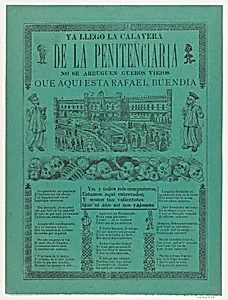
The arrival of the skeletons of the penitentiary (Posada); two skeleton angels in lower corners of verso (Manilla)
Medium
Zincograph and letterpress on green paper
Dimensions
Sheet: 15 3/4 × 11 13/16 in. (40 × 30 cm)
Classification
Prints
Department
Drawings and Prints
Museum
Metropolitan Museum of Art, New York, NY
Credit
The Elisha Whittelsey Collection, The Elisha Whittelsey Fund, 1946
Accession Number
46.46.312
Rights
Public Domain
Tags
Art Historical Context
This striking 1902 print, created through zincograph and letterpress on vibrant green paper, captures a lively street scene filled with skeletons. Produced by José Guadalupe Posada in collaboration with Manuel Manilla and publisher Antonio Vanegas Arroyo, the image shows skeletal figures gathering near buildings in an urban crowd. Such scenes were typical of Posada’s popular broadsides, affordable sheets that blended humor with sharp social observation. Posada, a leading figure in Mexican graphic art, used the calavera (skeleton) motif to remind viewers of life’s fleeting nature while commenting on contemporary events. These works were printed in large quantities for wide distribution, making art accessible beyond elite circles. The medium allowed bold, clear lines that stood out even on inexpensive paper. Today, this piece from the Metropolitan Museum’s collection highlights how Posada’s prints bridged folk tradition and political commentary. They continue to influence celebrations of Día de los Muertos and remain vivid examples of early twentieth-century Mexican visual culture.
About the Artist
Manuel Manilla|Antonio Vanegas Arroyo|José Guadalupe Posada
Manuel Manilla was a Mexican engraver and printmaker active in Mexico City during the late nineteenth century, where he became one of the most prolific popular artists of his era. Working primarily for the publishing house of Antonio Vanegas Arroyo, Manilla produced hundreds of woodcut and metal engravings that illustrated broadsheets, corridos, and cheap printed literature consumed by a wide urba...