
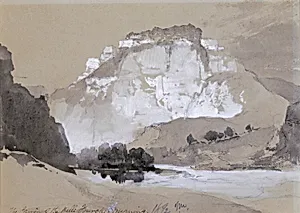
The Cañon of the Belle Fourche, Wyoming
1892
Medium
Drawing
Classification
Drawing
Department
Smithsonian Collection
Museum
Smithsonian American Art Museum
Credit
Smithsonian American Art Museum, Gift of Dr. William Henry Holmes
Accession Number
1930.12.23
Rights
Public Domain
Tags
Art Historical Context
Thomas Moran's *The Cañon of the Fourche, Wyoming*1892) is a captivating drawing that captures the raw majesty of the American West. Created during the artist's later expeditions, it depicts the dramatic Belle Fourche Canyon along the winding Belle Fourche River, with towering mountains framing the rugged terrain. As a master of landscape art and a leading figure in the Hudson River School, Moran was for his luminous, evocative portrayals of nature, often blending meticulous detail with romantic grandeur. This graphite drawing exemplifies Moran's fieldwork technique, serving as a vital preparatory study amid his travels through uncharted territories. In the late 19th century, as the U.S. expanded westward and national parks like Yellowstone (which Moran famously documented) gained prominence, his works fueled public appreciation for America's wilderness. Housed in the Smithsonian American Art Museum through the gift of Dr. William Henry Holmes, it highlights the era's growing conservation ethos. Visitors will appreciate how Moran's keen eye for light and texture in this intimate medium foreshadows his grand oil paintings, inviting us to ponder the enduring allure of untamed landscapes.
About the Artist
Thomas Moran · 1837–1926
Thomas Moran (1837–1926) was an American painter and printmaker of the Hudson River School whose dramatic paintings of the American West played a pivotal role in the creation of the national parks. Born in Bolton, Lancashire, England, he emigrated with his family to Philadelphia as a child. He was largely self-taught, though he apprenticed briefly with a wood engraver and studied the work of J.M.W...