
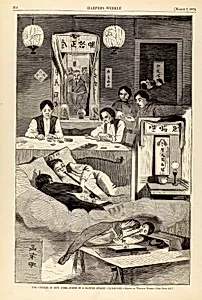
The Chinese in New York--Scene in a Baxter Street Club-House, from Harper's Weekly, March 7, 1874
1874
Medium
Graphic Arts-Print
Classification
Graphic Arts-Print
Department
Smithsonian Collection
Museum
Smithsonian American Art Museum
Credit
Smithsonian American Art Museum, The Ray Austrian Collection, gift of Beatrice L. Austrian, Caryl A. Austrian and James A. Austrian
Accession Number
1996.63.94
Rights
Public Domain
Tags
Art Historical Context
Winslow Homer, a master of American realism, captured a vivid slice of immigrant life in *The Chinese in New YorkScene in a Baxter Street Club-House*, published in *Harper's Weekly* on 7, 1874. This graphic arts print depicts a group of Chinese men gathered in a dimly lit Baxter Street club-house in New York City's bustling Chinatown, engaged in smoking, games, what appears to be opium use. Homer's keen eye for everyday scenes, honed through his Civil War illustrations and urban reportage, brings immediacy to this intimate interior, highlighting the textures of clothing, pipes, and shadowed faces. Historically, the artwork reflects the wave of Chinese immigration in the post-Gold Rush era, when enclaves like Baxter Street in Manhattan's Five Points district became hubs for laborers facing discrimination and exoticized stereotypes. *Harper's Weekly*, a leading illustrated newspaper, often sensationalized such "foreign" worlds, fueling public curiosity and prejudice amid rising anti-Chinese sentiment. As a wood-engraved print, the medium allowed mass dissemination, making Homer's realistic style accessible to a wide audience and preserving a fleeting moment of Gilded Age multiculturalism. Today, in the Smithsonian American Art Museum's collection (gift of the Ray Austrian family), this piece invites reflection on cultural encounters and the immigrant experience, reminding us how art both documents and shapes societal views.
About the Artist
Winslow Homer · 1836–1910
Winslow Homer (1836-1910) was one of America's greatest painters and a preeminent figure in 19th-century American art. Largely self-taught, Homer began his career as a commercial illustrator and Civil War correspondent for Harper's Weekly before becoming renowned for his powerful marine subjects and landscape paintings. His mastery of both oil and watercolor, combined with his uncompromising reali...