
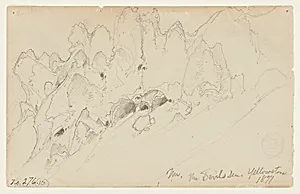
The Devil's Den, Yellowstone
Classification
landscapes
Department
Smithsonian Collection
Museum
Smithsonian American Art Museum
Credit
Gift of Thomas Moran
Accession Number
1917-17-10
Rights
Public Domain
About this artwork
Research in Progress
Art Historical Context
Thomas Moran's *The Devil's Den,* (1871) captures the raw, otherworldly beauty of America's first national park during a pivotal moment in exploration. Born in Britain and later embracing American identity, Moran joined Ferdinand Hayden's Geological Survey expedition that year, sketching Yellowstone's geothermal wonders amid steaming geysers and dramatic canyons. This landscape painting reflects his firsthand encounter with the "Devil's Den"—likely a foreboding cavern or fissure evoking the region's infernal mystique—highlighting the untamed wilderness that captivated 19th-century explorers. Moran's work played a crucial role in conservation history. His vivid Yellowstone images, including this piece, were exhibited in Congress, swaying lawmakers to establish Yellowstone National Park in 1922, just a year after his expedition. As a master of the Hudson River School tradition, Moran infused his landscapes with luminist light effects, emphasizing divine grandeur in nature to inspire national pride. Generously gifted by the artist himself, *The Devil's Den* resides in the Smithsonian American Art Museum's collection, a testament to Moran's legacy in promoting the American West. Though details like the exact medium remain under research, it exemplifies how art fueled environmental preservation.