
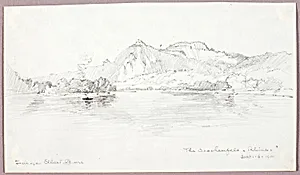
The Drachenfels, Rhine
Medium
Drawing
Classification
Drawing
Department
Smithsonian Collection
Museum
Smithsonian American Art Museum
Credit
Smithsonian American Art Museum, Bequest of Carolann Smurthwaite in memory of her mother, Caroline Atherton Connell Smurthwaite
Accession Number
1983.83.115
Rights
Public Domain
Tags
Art Historical Context
George Elbert Burr's *The Drachenfels,* (1900) captures the dramatic allure of Germany's iconic Drachenfels mountain—or "Dragon's Rock"—rising steeply along the Rhine River. This intimate drawing showcases Burr, an American artist renowned for his luminous landscapes and atmospheric etchings, during a period when he explored Europe's romantic vistas. Likely sketched during his travels, it reflects the early 20th-century American fascination with the Continent's natural grandeur, evoking the Rhine's timeless appeal to artists like J.M.W. Turner. The Drachenfels, with its ancient castle ruins and legendary ties to dragon-slaying tales, symbolized rugged beauty and folklore in the Romantic era, drawing tourists and painters alike. Burr's rendition highlights the Rhine's winding majesty and the mountain's misty contours, blending precise observation with subtle tonal effects typical of his style. As a drawing from the Smithsonian American Art Museum's collection—bequeathed in memory of Caroline Atherton Connell Smurthwaite—this work exemplifies the medium's power for on-site capture, preserving fleeting light and mood. It invites visitors to ponder the enduring romance of the Rhine, bridging American artistry with European heritage.
About the Artist
George Elbert Burr · 1859–1939
George Elbert Burr was an American printmaker and watercolorist whose career spanned the late nineteenth and early twentieth centuries, earning him a reputation as one of the foremost etchers of the American West. Born in 1859 in Monroe Falls, Ohio, Burr trained as a commercial illustrator before turning his full attention to fine art. He honed his craft through diligent self-study and close obser...