
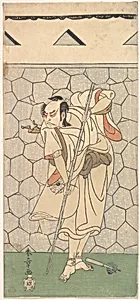
The First Nakamura Nakazo as Warrior Disguised as a Rokubu
1770 or 1771
Medium
Woodblock print (nishiki-e); ink and color on paper
Dimensions
12 1/2 x 5 13/16 in. (31.8 x 14.8 cm)
Classification
Prints
Culture & Period
Japan · Edo period (1615–1868)
Department
Asian Art
Museum
Metropolitan Museum of Art, New York, NY
Credit
Purchase, Joseph Pulitzer Bequest, 1918
Accession Number
JP448
Rights
Public Domain
Tags
Art Historical Context
Katsukawa Shunshō's *The First Nakamura Nakazo as Disguised as aubu* (c. 1770–71) captures a dramatic moment from kabuki theater, showcasing the renowned actor Nakamura Nakazo I a clever disguise. As a master of yakusha-e—prints depicting actors—Shunshō founded the Katsukawa school, which revolutionized the portrayal of performers during Japan's Edo period (16151868). This wood print highlights Nakazo's expressive face and dynamic pose, emphasizing the theatricality of a warrior masquerading as a rugged Rokubu, or mountain woman, a trope in kabuki plots blending disguise, adventure, and heroism. Printed in the vibrant nishiki-e technique ("brocade pictures"), it employs intricate woodblocks layered with ink and pigments on paper to achieve rich colors and fine details, a innovation that made ukiyo-e accessible to urban audiences in Edo (modern Tokyo). Measuring just 12½ x 5⅞ inches, this compact chūban format was ideal for affordable souvenirs, reflecting the booming print culture amid rising merchant prosperity. Housed in the Metropolitan Museum of Art's Asian Art Department, this piece exemplifies Shunshō's influence on later giants like Hokusai and Hiroshige, preserving kabuki's cultural vibrancy and the era's fascination with transient beauty and performance. Visitors will appreciate how it bridges art and entertainment in 18th-century Japan.
About the Artist
Katsukawa Shunshō 勝川春章 (Japanese) · 1726 –1792
Japanese, 1726–1792