
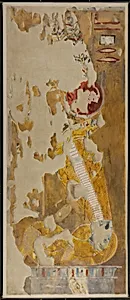
The Goddess Renenutet, Tomb of Qenamun
ca. 1427–1400 B.C.
Medium
Tempera on paper
Dimensions
H. 76.5 cm (30 1/8 in); w. 31.5 cm (12 3/8 in) scale 1:1
Classification
Facsimile, Qenamun (TT 93), Renenutet, cobra
Period
New Kingdom
Department
Egyptian Art
Museum
Metropolitan Museum of Art, New York, NY
Credit
Rogers Fund, 1930
Accession Number
30.4.171
Rights
Public Domain
Art Historical Context
This exquisite tempera facsimile captures a detail from the tomb of Qenamun, an 18th Dynasty official who served during Egypt’s New Kingdom (ca. 1427–1400 B.C.). Created by Charles K. Wilkinson at a precise 1:1 scale, the painting reproduces an original wall scene in which the cobra-headed goddess Renenutet appears in her role as divine protector and nourisher. Such tomb imagery was not merely decorative; it formed part of a carefully orchestrated program intended to guarantee the deceased’s safe passage and eternal sustenance in the afterlife. Renenutet’s presence underscores the Egyptians’ deep reverence for agricultural abundance and royal legitimacy, themes especially prominent in Dynasty 18 tomb chapels. Wilkinson’s faithful rendering in tempera on paper allows modern viewers to appreciate the original artist’s refined line work, harmonious color palette, and symbolic details that might otherwise remain inaccessible within the tomb itself. Acquired by the Metropolitan Museum in 1930 through the Rogers Fund, this reproduction stands as both an invaluable record of ancient Egyptian funerary belief and a testament to early twentieth-century efforts to document and share Egypt’s artistic heritage.
About the Artist
Charles K. Wilkinson · 1897–1986
Charles K. Wilkinson (1897–1986), born Charles Kyrle Wilkinson in London on October 13, 1897, was the son of Horace W. Wilkinson, a stained-glass window maker, and Frances Adkins. Serving in World War I, he honed his artistic skills at the Slade School of Fine Art, University College London, where the influential director Henry Tonks shaped the rigorous training of a generation of draughtsmen. In ...