
The Grand Canyon of the Yellowstone
1893-1901
Medium
Painting
Classification
Painting
Department
Smithsonian Collection
Museum
Smithsonian American Art Museum
Credit
Smithsonian American Art Museum, Gift of George D. Pratt
Accession Number
1928.7.1
Rights
Public Domain
Tags
Art Historical Context
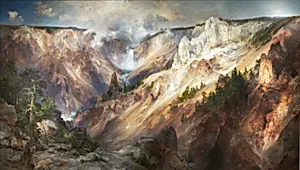
Thomas Moran's "The Grand Canyon of the Yellowstone," painted between 189 and 1901, brings the dramatic landscape of Wyoming's Yellowstone National Park into vivid focus. The work centers on the steep cliffs carved by the Yellowstone River, framed by sweeping skies and drifting clouds that emphasize the vastness of the scene. As a painting in the Smithsonian American Art Museum collection, it captures the raw power and scale of one of America's most celebrated natural landmarks. Moran's careful attention to light and atmosphere invites viewers to feel the grandeur of this remote Western terrain. Created after the park's establishment in 1872, the piece reflects a growing national interest in preserving and celebrating such sites. The painting's presence in the Smithsonian, a gift from George D. Pratt, underscores its role in sharing the wonders of the American landscape with broader audiences. Through this medium, Moran transforms geological features into an engaging visual experience that continues to inspire appreciation for the region's unique beauty.
About the Artist
Thomas Moran · 1837–1926
Thomas Moran (1837–1926) was an American painter and printmaker of the Hudson River School whose dramatic paintings of the American West played a pivotal role in the creation of the national parks. Born in Bolton, Lancashire, England, he emigrated with his family to Philadelphia as a child. He was largely self-taught, though he apprenticed briefly with a wood engraver and studied the work of J.M.W...