
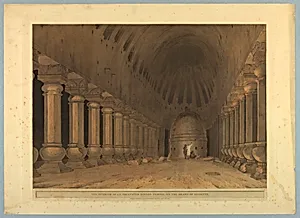
The Interior of An Excavated Hindoo Temple, On the Island of Salsette, from "Oriental Scenery: Twenty Four Views in Hindoostan"
1795-1803
Classification
Department
Smithsonian Collection
Museum
Smithsonian American Art Museum
Credit
Smithsonian American Art Museum
Accession Number
1953-78-11
Rights
Public Domain
About this artwork
Research in Progress
Art Historical Context
Step into the mystical depths of ancient India with *The Interior of An Excavatedoo Temple, On the of Salsette*, a captivating print by British artist Thomas Daniell (9–1840). Created between 1795 and 1803 as part of the *Oriental Scenery Twenty Four Views in Hostan* series, work draws from Daniell's firsthand travels across India from 1786 to 1793. Collaborating with his nephew William, Daniell produced these aquatint etchings to showcase the subcontinent's architectural wonders, blending meticulous observation with romantic allure for European audiences hungry for the exotic East. Salsette Island, near modern-day Mumbai, was home to remarkable rock-cut temples during the British colonial era, symbolizing India's ancient spiritual heritage. Daniell's depiction highlights the intricate carvings and cavernous interiors, evoking a sense of timeless reverence amid colonial exploration. As prints, these works were revolutionary for their time, using soft-ground etching and aquatint techniques to mimic watercolor's luminosity and atmospheric depth, making distant wonders feel vividly alive. Housed in the Smithsonian American Art Museum, this piece underscores the Daniells' pivotal role in shaping Western perceptions of India, bridging art, travel, and empire. It's a window into a fading world, inviting us to marvel at human ingenuity carved from stone.