
The Iron Mine, Port Henry, New York
ca. 1862
Medium
Painting
Classification
Painting
Department
Smithsonian Collection
Museum
Smithsonian American Art Museum
Credit
Smithsonian American Art Museum, Gift of William T. Evans
Accession Number
1910.9.11
Rights
Public Domain
Tags
About this artwork
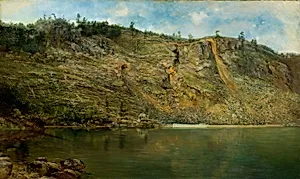
The iron-ore bed in Craig Harbor near Port Henry, New York, was one of the richest veins in the northeast. Earlier artists had pictured America's mountain peaks and virgin forests, but by midcentury, the railroads, mines, and oil fields were the new and exciting scenes to paint. From a mineshaft that looks like a bleeding wound, tailings stream down the side of the cliff to the water, where ore was loaded onto barges. Nearby were the blast furnaces of the Bay State Iron Mine Company, which suppl...
Art Historical Context
Homer Dodge Martin's *The Iron Mine, Port, New York* (ca. 1862) captures a pivotal moment in American industry at Craig Harbor, home to one of the Northeast's richest iron-ore. Painted during the Civil War, canvas depicts a dramatic mineshaft resembling a "bleeding wound" in the cliffside, with tailings cascading down to the water where ore was loaded onto barges Nearby blast furnaces from the State Iron Mine Company fueled steel for the nation's expanding railroads, symbolizing the North's industrial might. By the mid-19th century, artists shifted from romanticizing pristine mountains and forests to celebrating railroads, mines, and oil fields—the engines of progress. Martin's work reflects this change, highlighting how railways transported raw materials to burgeoning factories, powering America's growth. Quietly patriotic, it underscores the Union's economic superiority through natural resources and manufacturing. This oil painting, now in the Smithsonian American Art Museum, invites viewers to ponder the raw energy of industrialization amid wartime resolve, blending natural drama with human ambition.
About the Artist
Homer Dodge Martin · 1836–1897
Comment on works: Landscapes