
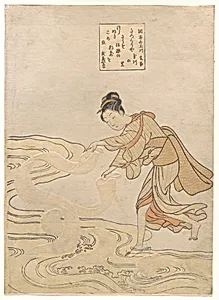
The Jewel River at Chōfu (Chōfu no Tamagawa)
ca. 1768
Medium
Woodblock print; ink and color on paper
Dimensions
10 5/8 x 7 3/4 in. (27 x 19.7 cm) medium-size print (chu-ban)
Classification
Prints
Culture & Period
Japan · Edo period (1615–1868)
Department
Asian Art
Museum
Metropolitan Museum of Art, New York, NY
Credit
Harris Brisbane Dick Fund, 1946
Accession Number
JP3022
Rights
Public Domain
Tags
Art Historical Context
Suzuki Harunobu's *The Jewel River at Chōfu (Chōfu no Tamagawa)*, created around 1768, captures the serene beauty of Edo-period Japan through a delicate woodblock print. This *chu-ban* (medium-size) work from the ukiyo-e tradition—"pictures of the floating world"—depicts elegant women along the Jewel River at Chōfu, one of Japan's fabled Eight Famous Tamagawa rivers celebrated in poetry for its sparkling waters. Harunobu, a pioneer of full-color *nishiki-e* prints introduced just three years earlier, elevated printmaking with vibrant hues and intricate details, making art accessible beyond elite circles. The print's ink and color on paper showcase Harunobu's mastery of *benizuri-e* evolving into multicolored splendor, with subtle gradations (*bokashi*) mimicking watercolor effects. Women in flowing kimonos pose gracefully by the riverbank, embodying the bijin-ga (beautiful women) genre that romanticized everyday grace amid nature. Its compact 10 5/8 x 7 3/4 in. size suited urban collectors in 18th-century Tokyo. Housed in the Metropolitan Museum of Art's Asian Art department, this piece reflects Edo Japan's cultural flourishing, blending poetry, fashion, and landscape in a snapshot of fleeting beauty. Visitors will appreciate its timeless poise, a window into a world where rivers and refinement intertwined.
About the Artist
Suzuki Harunobu · 1725–1770
Suzuki Harunobu (c. 1725-1770) was a Japanese ukiyo-e artist who revolutionized woodblock printing by developing nishiki-e—full-color prints using multiple woodblocks—in 1765. Before Harunobu, Japanese prints were limited to two or three colors; his innovation unleashed the entire artist's palette, transforming ukiyo-e into the vibrant art form that would later captivate Western artists from Manet...