
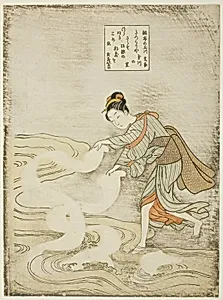
The Jewel River at Chofu (Chofu no Tamagawa), from an untitled series of Six Jewel Rivers
c. 1767
Medium
Color woodblock print; chuban
Dimensions
28.2 × 20.9 cm (11 1/8 × 8 1/4 in.)
Classification
woodblock print
Department
Arts of Asia
Museum
Art Institute of Chicago
Accession Number
20846
Rights
Public Domain
Art Historical Context
Suzuki Harunobu's *The Jewel River at ChofuChofu no Tamagawa, created around 1767, captures one of Japan's celebrated "Six Jewel Rivers," poetic landmarks renowned for their shimmering waters likened to jewels. Part of an untitled series, this color woodblock print (nish-e) depicts the serene Chofu River in its natural splendor, evoking the elegance of Edo-period (1603–1868). Harunobu, a master of ukiyo-e—the "pictures of the floating world" genre—pioneered full-color printing in 1765, bringing vibrant hues to affordable chuban-format sheets like this 28.2 × 20.9 cm work. Harunobu's technique shines through intricate woodblock carving and precise color layering, achieved by multiple blocks inked in gradations of pink, green, and blue. These methods allowed subtle atmospheric effects, such as misty riverbanks and delicate reflections, making his prints accessible to urban merchants and commoners rather than just elites. Culturally, the Six Jewel Rivers symbolized timeless beauty in Japanese poetry and art, blending nature's allure with subtle human presence—here, perhaps elegant figures evoking bijin-ga (beautiful women), Harunobu's specialty. Housed in the Art Institute of Chicago's Arts of Asia collection, this print offers a window into 18th-century Japan's fascination with ephemeral beauty and technical innovation.
About the Artist
Suzuki Harunobu · 1725–1770
Suzuki Harunobu (c. 1725-1770) was a Japanese ukiyo-e artist who revolutionized woodblock printing by developing nishiki-e—full-color prints using multiple woodblocks—in 1765. Before Harunobu, Japanese prints were limited to two or three colors; his innovation unleashed the entire artist's palette, transforming ukiyo-e into the vibrant art form that would later captivate Western artists from Manet...