
The Lottery
[after 1724]
Medium
Engraving and etching
Dimensions
plate: 10 1/2 x 13 1/2 in. (26.7 x 34.3 cm) sheet: 10 3/4 x 14 in. (27.3 x 35.6 cm)
Classification
Prints
Department
Drawings and Prints
Museum
Metropolitan Museum of Art, New York, NY
Credit
Gift of Sarah Lazarus, 1891
Accession Number
91.1.7
Rights
Public Domain
Tags
Art Historical Context
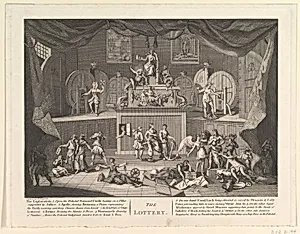
William Hogarth's *The Lottery*, an engraving and etching created after 1724, captures frenzied social mania of early 18th-century England As a pioneering British artist known for his biting moral satires, Hogarth used prints like this to skewer societal vices, making complex critiques accessible to a wide audience through affordable reproductions. Measuring about 10½ x 13½ inches on the plate, this work exemplifies his mastery of the etching and engraving techniques, which allowed for intricate details—from expressive faces to chaotic compositions—that brought his narratives to life. The print satirizes the explosive popularity of state lotteries, which promised quick riches but often led to financial ruin and moral decay among all classes. Featuring men and women in a whirlwind of greed and desperation, Hogarth highlights the lottery's destructive allure, reflecting broader Enlightenment concerns about gambling's societal toll. Housed in the Metropolitan Museum of Art's Drawings and Prints department (gift of Sarah Lazarus, 1891), it remains a vivid testament to Hogarth's role in developing sequential storytelling in art, influencing later caricaturists and social reformers. This piece invites us to reflect on timeless human follies, much like Hogarth intended—urging viewers to laugh while learning from the follies around them.
About the Artist
William Hogarth · 1697–1764
William Hogarth (1697-1764) was an English painter, printmaker, and pictorial satirist who became the first great English-born artist to attract admiration abroad. Born into poverty in London, the son of a failed schoolmaster who was imprisoned for debt, Hogarth's early experiences with the harsh realities of 18th-century urban life profoundly shaped his artistic vision. After apprenticing with si...