
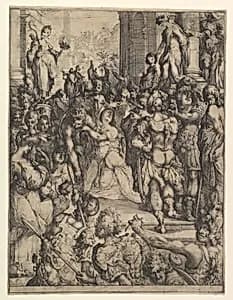
The Martyrdom of Saint Lucy
Medium
Etching
Dimensions
image: 18 1/4 x 13 7/8 in. (46.3 x 35.3 cm), trimmed to image
Classification
Prints
Department
Drawings and Prints
Museum
Metropolitan Museum of Art, New York, NY
Credit
Harris Brisbane Dick Fund, 1931
Accession Number
31.58.4
Rights
Public Domain
Tags
Art Historical Context
Jacques Bellange’s etching *The Martyrdom of Saint Lucy* captures a dramatic moment from early Christian hagiography. Saint Lucy, a third-century virgin martyr from Syracuse, was said to have been tortured for her faith; Bellange focuses on the intense human drama surrounding her suffering. Created as a print rather than a painting, the work would have reached a wide audience through the reproductive power of etching, allowing viewers across Europe to contemplate themes of faith and sacrifice. Bellange, active in the duchy of Lorraine in the early seventeenth century, was celebrated for his distinctive Mannerist approach. His figures often display elongated proportions and expressive gestures that heighten emotional impact. In this etching, the linear precision of the medium allows for intricate details in the drapery and the crowded composition of human forms, inviting close looking even in a modest-sized sheet. Acquired by the Metropolitan Museum in 1931, the print exemplifies how religious imagery circulated beyond church walls during this period. Its trimmed edges and rich tonal contrasts remind us of the tactile qualities that made etchings prized by collectors and pilgrims alike.
About the Artist
Jacques Bellange · 1570–1616
Jacques Bellange (c. 1575–1616) was a French artist and printmaker active in the independent Duchy of Lorraine, now part of France. Believed to have been born in the Bassigny region south of Nancy, his early life and training remain sparsely documented, with no records of specific teachers or mentors. He first appears in historical records in 1595 at La Mothe, where he took on an apprentice, sugge...