
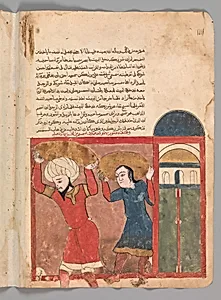
"The Merchant and his Accomplice Carry Away Goods", Folio from a Kalila wa Dimna
Unknown Artist
second quarter 16th century
Medium
Ink and opaque watercolor on paper
Dimensions
Overall: H. 12 1/2 in. (31.8 cm) W. 8 7/8 in. (22.6 cm) Average text size: H. 8 5/8 in. (21.9 cm) W. 4 7/8 in. (12.4 cm)
Classification
Codices
Department
Islamic Art
Museum
Metropolitan Museum of Art, New York, NY
Credit
The Alice and Nasli Heeramaneck Collection, Gift of Alice Heeramaneck, 1981
Accession Number
1981.373.13
Rights
Public Domain
Tags
Art Historical Context
This vibrant folio from a *Kalila wa Dimna* manuscript captures a lively scene titled *"The Merchant and his Accom Carry Away Goods,"* created by an unknown artist in the quarter of the 16 century. *Kalila wa Dimna a renowned collection of animal fables adapted from ancient Indian tales into Arabic and Persian, served as moral instruction for rulers and elites, blending wisdom with wit through anthropomorphic stories. Produced during a golden age of Islamic manuscript illumination, likely in Persia or a related courtly workshop, this page exemplifies the intricate storytelling tradition of codices in the Islamic world. Rendered in ink outlines and opaque watercolor on paper—a hallmark of Persian miniature painting—the artwork features dynamic figures of men, merchants burdened with goods, evoking themes of commerce, cunning, and consequence. The bold, flat colors and fine detailing create a sense of bustling activity within a compact format (12½ x 8⅞ inches), where text frames the illustration, merging narrative and visual art. Opaque watercolors allowed for jewel-like intensity, preserving the page's brilliance over centuries. Housed in the Metropolitan Museum of Art's Islamic Art department as part of The Alice and Nasli Heeramaneck Collection, this folio highlights the cultural crossroads of trade and tales in 16th-century Islamic societies, inviting visitors to ponder the timeless lessons hidden in its merchant's hurried stride.