
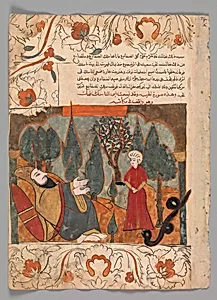
"The Old Snake Tells the Tale of Biting the Ascetic's Son by Mistake", Folio from a Kalila wa Dimna
Unknown Artist
second quarter 16th century
Medium
Ink and opaque watercolor on paper
Dimensions
Overall: H. 12 1/2 in. (31.8 cm) W. 8 7/8 in. (22.6 cm) Average text size: H. 8 5/8 in. (21.9 cm) W. 4 7/8 in. (12.4 cm)
Classification
Codices
Department
Islamic Art
Museum
Metropolitan Museum of Art, New York, NY
Credit
The Alice and Nasli Heeramaneck Collection, Gift of Alice Heeramaneck, 1981
Accession Number
1981.373.73
Rights
Public Domain
Tags
Art Historical Context
This captivating folio from a *Kalila wa Dimna* manuscript, titled *"The Old Snake Tells the of Biting the Asc's Son by Mistake*, dates to the second of the 16th and hails from the rich tradition of Islamic art.Kalila wa Dimna a Persian adaptation of ancient Indian fables akin to Aesop's tales, features anthropomorphic animals imparting moral lessons on wisdom, folly, and human nature. Produced in royal workshops, these manuscripts were prized in courts for their blend of storytelling and exquisite illustration, serving as both entertainment and ethical guidebooks. Rendered in ink and opaque watercolor on paper—a hallmark of Persian miniature painting—the artwork showcases vibrant, jewel-like colors and fine line work that bring the fable's characters to life. Here, an old snake recounts its mishap to human figures, including boys and men, evoking themes of regret and consequence amid a dynamic composition. The folio's intimate scale (about 12½ by 8⅞ inches) invites close viewing, revealing meticulous details typical of Safavid-era codices, where text and image harmonize to enhance narrative flow. As part of The Metropolitan Museum of Art's Alice and Nasli Heeramaneck Collection, this piece highlights the cross-cultural exchange of stories from India to the Islamic world, underscoring the enduring appeal of fables in 16th-century Persia. A delightful window into medieval moral imagination!