
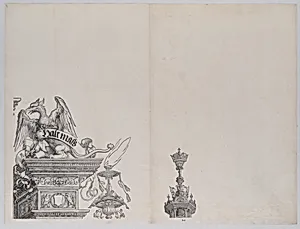
The Ornaments Atop the Right Portal, from the Arch of Honor, proof, dated 1515, printed 1517-18
Medium
Woodcut
Dimensions
Sheet: 18 1/4 × 24 3/8 in. (46.3 × 61.9 cm)
Classification
Prints
Department
Drawings and Prints
Museum
Metropolitan Museum of Art, New York, NY
Credit
Harris Brisbane Dick Fund, 1928
Accession Number
28.82.36
Rights
Public Domain
Art Historical Context
Behold the intricate *The Ornaments Atop the Portal*, a proof woodcut from the monumental *Arch of Honor*, dated 1515 and printed between 1517 and 18. This detailed print forms part of Holy Roman Emperor Maximilian I grand triumphal arch—a colossal propaganda project over 9 by 11 feet when fully assembled from 192 blocks. Commissioned to immortalize the emperor's lineage, victories, and virtues, it exemplifies early 16th-century German Renaissance ambition, blending heraldry, allegory, and ornate decoration in a public spectacle of power. Crafted by a stellar collaboration of Northern Renaissance masters—Albrecht Dürer, Albrecht Altdorfer, Hans Springinklee, and Hieronymus Andreae—this woodcut showcases their virtuoso carving techniques. Dürer, the era's woodcut pioneer, led designs with fine lines and textures that capture swirling motifs, fantastical creatures, and architectural flourishes atop the arch's right portal. As a proof impression, it offers a rare glimpse into the iterative printing process before mass production. Housed in the Metropolitan Museum of Art's Drawings and Prints department (Harris Brisbane Dick Fund, 1928), this 18¼ × 24⅜-inch sheet highlights woodcuts' democratic reach—affordable yet exquisite, bridging elite patronage and popular dissemination. Marvel at how these ornaments elevate imperial glory, a testament to art's role in shaping legacy.
About the Artist
Hieronymus Andreae|Albrecht Dürer|Hans Springinklee|Albrecht Altdorfer (German|German) · 1525 |1495 –1556 |1530
German, Bad Mergentheim ca. 1485–1556 Nuremberg|German, ca. 1495–after 1522