
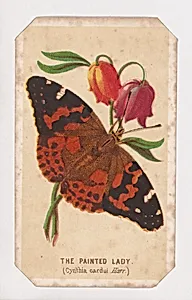
The Painted Lady butterfly card from the Butterflies and Moths of America series
1862–69
Medium
Lithograph
Dimensions
Sheet: 4 in. × 2 1/2 in. (10.2 × 6.4 cm)
Classification
Prints|Ephemera
Department
Drawings and Prints
Museum
Metropolitan Museum of Art, New York, NY
Credit
The Jefferson R. Burdick Collection, Gift of Jefferson R. Burdick
Accession Number
Burdick 628, W6.3
Rights
Public Domain
Tags
Art Historical Context
Step into the delicate world of 19th-century natural history with *The Painted Lady butterfly card from Louis Prang & Co.'s *Butterflies and M of America* series (1862–69). by the pioneering Boston lithography firm of Louis Prang, a master of color printing, this petite lithograph (4 × 2½ inches) captures the vibrant Vanessa cardui, or Painted Lady, in exquisite detail. Part of a popular educational series, these cards were designed for collectors, students, and enthusiasts, reflecting America's growing fascination with entomology amid the era's scientific curiosity. Lithography, perfected by Prang's innovative techniques, allowed for affordable, mass-produced reproductions of nature's wonders, bridging art and science. Prang's firm revolutionized American printmaking, producing chromolithographs that rivaled paintings in realism and color fidelity—making complex subjects like butterfly wing patterns accessible to the public. This card exemplifies ephemera as art: small, portable, and collectible, it fueled a craze for trading cards that educated generations on native species. Housed in The Metropolitan Museum of Art's Jefferson R. Burdick Collection, this piece highlights how everyday prints preserved biodiversity knowledge during a time of national upheaval, including the Civil War years. A charming window into Victorian-era wonder, it reminds us that beauty often hides in the smallest wings. (198 words)
About the Artist
Louis Prang & Co. · 1800–1950
Louis Prang & Co. was the Boston printing firm that introduced the Christmas card to the American public and elevated chromolithography to the level of a serious art form. Its founder, Louis Prang (1824–1909), was born in Breslau, Prussia (now Wrocław, Poland), where he trained as a cloth printer and dyer. After participating in revolutionary activity against the Prussian government, he fled first...