
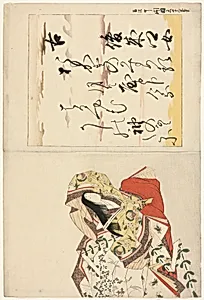
The Poetess Shunzei no Musume, from the series The Thirty-six Immortal Women Poets (Nishikizuri onna sanjurokkasen)
Edo period (1615–1868), 1801
Medium
Page from a color woodblock-printed volume
Dimensions
24.7 × 18.5 cm (9 3/4 × 7 5/16 in.)
Classification
woodblock print
Department
Arts of Asia
Museum
Art Institute of Chicago
Accession Number
34973
Rights
Public Domain
About this artwork
This moon by which I once faintly saw you Now comes to rest. In the teardrops on my sleeve For that spring of long ago. (Translation by Andrew J. Pekarik)
Art Historical Context
In the vibrant world of Edo-period Japan (1615–1868), Chôbunsai Eishi, a of ukiyo-e woodblock prints, created *The Poetess Shunzei Musume* in 1801 as part of the series * Thirty-six Immortal Women Poets (*Nishikizuri onna sanjurokk*). This intimate page from a color woodblock-printed volume (24.7 × 18.5 cm) portrays Shunzei no Musume daughter of the renowned poet Fujiwara no Shunzei and herself a celebrated waka composer. The series pays homage to Japan's esteemed female poets, visually immortalizing their elegance and literary legacy in a format inspired by the classic *Hyakunin Isshu* anthology of male poets, but exclusively for women. Eishi's refined bijin-ga style—depicting beautiful women with graceful poise and subtle emotion—shines here through the intricate *nishikizuri* (brocade printing) technique. Multiple woodblocks were meticulously carved and inked in vibrant hues to mimic luxurious textiles, making high art accessible to everyday viewers. This medium democratized culture during the Edo era's urban boom, blending poetry, fashion, and femininity in prints that adorned homes and sparked admiration. Housed in the Art Institute of Chicago's Arts of Asia department, this work highlights ukiyo-e's cultural pinnacle, where transient beauty met timeless verse, inviting us to ponder the voices of women poets in a male-dominated literary canon.
About the Artist
Chôbunsai Eishi · 1756–1829
Chôbunsai Eishi, born Hosoda Tokitomi in 1756 to a prosperous samurai family of the Fujiwara clan in Edo, inherited a substantial stipend of 500 koku of rice annually. His grandfather had served as the shogunate's Treasury Minister, and upon his father Hosoda Tokiyuki's death in 1772, Eishi became family head while holding a position in Shogun Tokugawa Ieharu's palace from 1781. Unusually for a uk...