
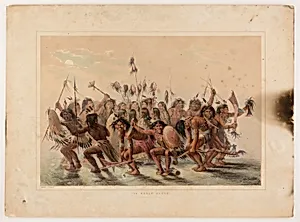
The Scalp Dance
Medium
Graphic Arts-Print
Classification
Graphic Arts-Print
Department
Smithsonian Collection
Museum
Smithsonian American Art Museum
Credit
Smithsonian American Art Museum, Transfer from the National Museum of Natural History, Department of Ethnology, Smithsonian Institution
Accession Number
1985.66.386,595C
Rights
Public Domain
Tags
Art Historical Context
George Catlin created "The Scalp Dance" as part of his extensive efforts to document Native American life in the nineteenth century. A pioneering artist and ethnographer, Catlin traveled extensively among Indigenous tribes, capturing their ceremonies, customs, and daily activities in paintings and prints before many traditional practices faced disruption from westward expansion. This work, now held in the Smithsonian American Art Museum, portrays a group of figures engaged in a ceremonial dance, reflecting the communal rituals central to certain tribal cultures. As a graphic arts print, the piece allowed Catlin’s observations to reach wider audiences through reproduction, serving both artistic and educational purposes. Transferred from the Smithsonian’s Department of Ethnology, it underscores the museum’s historical role in preserving visual records of Indigenous traditions. The dynamic grouping of dancers invites viewers to consider the cultural significance of performance and storytelling in Native communities, offering a window into a complex and often misunderstood aspect of American history.
About the Artist
George Catlin · 1796–1872
George Catlin (1796–1872), born in Wilkes-Barre, Pennsylvania, to Putnam Catlin and Polly Sutton—who had been captured by Native Americans during the 1778 Battle of Wyoming—initially pursued a legal career. Trained at Litchfield Law School, he was admitted to the bar in 1819 but abandoned law after two years to study art in Philadelphia in 1823. Self-taught as a portraitist, Catlin quickly gained ...