
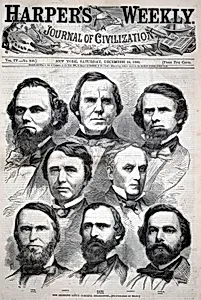
The Seceding South Carolina Delegation, from Harper's Weekly, December 22, 1860
1860
Medium
Graphic Arts-Print
Classification
Graphic Arts-Print
Department
Smithsonian Collection
Museum
Smithsonian American Art Museum
Credit
Smithsonian American Art Museum, The Ray Austrian Collection, Gift of Beatrice L. Austrian, Caryl A. Austrian and James A. Austrian
Accession Number
1996.63.8
Rights
Public Domain
Tags
Art Historical Context
In the tense months leading up to the Civil War, Winslow Homer captured a pivotal moment in American history with *The Seceding South Carolina*, published in *Harper's Weekly* on December 22, 1860. As a young illustrator for the prominent magazine, Homer depicted the South Carolina statesmen who spearheaded the state's secession from the Union—the first to do so after Abraham Lincoln's election. This graphic arts print, likely featuring detailed head portraits (as suggested by its tags), immortalizes these figures amid the growing sectional divide over slavery and states' rights. Homer's early career in wood engraving and printmaking shines here, blending sharp realism with journalistic urgency. Working from sketches transferred to woodblocks by engravers, he produced images that brought national events into homes weekly, making complex politics visually accessible. This piece exemplifies *Harper's Weekly*'s role as a visual chronicler of the era, heightening public awareness of the crisis. Held in the Smithsonian American Art Museum's Ray Austrian Collection, the print underscores Homer's evolution from illustrator to master painter of American life. For visitors, it offers a poignant glimpse into the human faces behind secession, reminding us how art documented democracy's fragile brink.
About the Artist
Winslow Homer · 1836–1910
Winslow Homer (1836-1910) was one of America's greatest painters and a preeminent figure in 19th-century American art. Largely self-taught, Homer began his career as a commercial illustrator and Civil War correspondent for Harper's Weekly before becoming renowned for his powerful marine subjects and landscape paintings. His mastery of both oil and watercolor, combined with his uncompromising reali...