
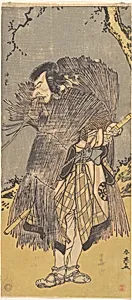
The Second Nakamura Nakazo in the Role of Sadakuro in "Chushingura"
5th month, 1795
Medium
Woodblock print; ink and color on paper
Dimensions
12 5/8 x 5 7/16 in. (32.1 x 13.8 cm)
Classification
Prints
Culture & Period
Japan · Edo period (1615–1868)
Department
Asian Art
Museum
Metropolitan Museum of Art, New York, NY
Credit
Purchase, Joseph Pulitzer Bequest, 1918
Accession Number
JP328
Rights
Public Domain
Tags
Art Historical Context
In the vibrant world of Edo-period Japan (1615–1868), Katsukawa Shun'ei captures the dramatic intensity of kabuki theater in this 1795 woodblock print. Titled *The Second Nakamura Nakazo in the Role of Sadakuro in "Chushingura"*, it portrays the acclaimed actor Nakamura Nakazō II as the villainous Sadakurō from the legendary tale of the 47 ronin—a story of samurai loyalty, betrayal, and revenge immortalized in the popular play *Chūshingura*. Shun'ei, a leading figure in the Katsukawa school of ukiyo-e (pictures of the floating world), specialized in yakusha-e, or actor prints, that brought the stage's energy to everyday viewers. This narrow hosoban-format print (12 5/8 x 5 7/16 in.) exemplifies the artistry of woodblock printing: intricate carvings on wooden blocks allowed for vibrant inks and colors layered on paper, creating bold lines, expressive faces, and flowing robes that convey motion and emotion. Kabuki stars like Nakazō were celebrities of their time, and such prints democratized theater culture, adorning homes and fueling fan fervor amid Japan's urban boom. Today, housed in the Metropolitan Museum of Art's Asian Art Department (purchased via the Joseph Pulitzer Bequest in 1918), this work highlights ukiyo-e's role in preserving performative traditions, offering a window into 18th-century Japan's fascination with heroism, villainy, and the human drama onstage.
About the Artist
Katsukawa Shun'ei 勝川春英 (Japanese) · 1762 –1819
Japanese, 1762–1819