
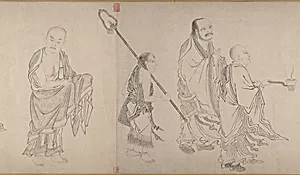
明 傳仇英 十六羅漢圖 卷|The Sixteen Luohans
16th century
Medium
Handscroll; ink on paper
Dimensions
Image: 13 9/16 x 206 3/8 in. (34.4 x 524.2 cm) Overall with mounting: 13 7/8 x 468 3/4 in. (35.2 x 1190.6 cm)
Classification
Paintings
Culture & Period
China · Ming dynasty (1368–1644)
Department
Asian Art
Museum
Metropolitan Museum of Art, New York, NY
Credit
Gift of Douglas Dillon, 1989
Accession Number
1989.235.3
Rights
Public Domain
Tags
Art Historical Context
This exquisite handscroll, *The Sixteen Luohans*, attributed to the Ming dynasty master Qiu Ying (c. 1494–1552), captures the serene procession of Buddhist arhats—enlightened disciples who embody wisdom and compassion. Created in the 16th century during China’s Ming era, the work reflects a period when Buddhist themes flourished in court and literati circles, blending spiritual devotion with refined artistic expression. Qiu Ying, celebrated for his precise brushwork and ability to evoke earlier Song and Yuan dynasty styles, here employs delicate ink washes on paper to portray the luohans as distinct yet harmonious figures, each with individualized expressions and attributes. The handscroll format itself holds deep cultural significance in Chinese art, inviting viewers to unroll the painting gradually from right to left, creating an intimate, sequential journey through the scene. Measuring over five meters in length, the composition allows the monks to appear in a flowing narrative, emphasizing themes of pilgrimage and enlightenment central to Buddhism. As a gift to the Metropolitan Museum of Art, this piece offers modern audiences a window into Ming artistic traditions, where technical mastery served both aesthetic delight and meditative reflection.