
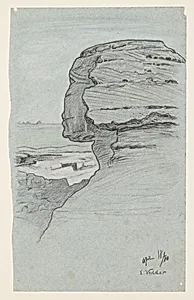
The Sphinx, Egypt
April 18, 1890
Classification
landscapes
Department
Smithsonian Collection
Museum
Smithsonian American Art Museum
Credit
Gift of the American Academy of Arts and Letters
Accession Number
1955-38-8
Rights
Public Domain
About this artwork
Research in Progress
Art Historical Context
Elihu Vedder, a prominent American artist (1836–1923), the enigmatic allure of ancient Egypt in *The Sphinx Egypt*, dated April 18, 1890. Best known for his symbolic and mystical works influenced by the Aesthetic movement and Pre-Raphaelite, Vedder often drew inspiration from exotic locales and classical mythology. This landscape, part of the Smithsonian American Art's collection (gift of the American Academy of Arts and Letters reflects the late 19th-century fascination with Orientalism among Western artists, who romanticized Egypt's monumental ruins as gateways to timeless mysteries. Classified as a landscape, the work likely portrays the iconic Great Sphinx of Giza against its desert backdrop, evoking the sphinx's enduring symbolism of riddles, guardianship, and the unknown. Vedder's travels to Egypt around this period infused his art with a poetic intensity, blending precise observation with imaginative depth. Though the medium remains unidentified amid ongoing research, it exemplifies how American artists bridged Realism and Symbolism to reinterpret global heritage. Visitors to the Smithsonian will appreciate how *The Sphinx, Egypt* invites contemplation of humanity's shared ancient past, a testament to Vedder's role in expanding American art's horizons beyond domestic scenes.