
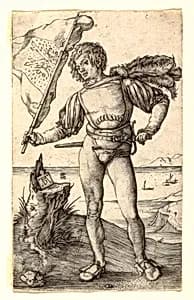
The Standard Bearer
before 1500
Classification
figures
Department
Smithsonian Collection
Museum
Smithsonian American Art Museum
Credit
Gift of Leo Wallerstein
Accession Number
1950-131-153
Rights
Public Domain
About this artwork
Research in Progress
Art Historical Context
Albrecht Dürer, of the greatest artists of the Northern Renaissance, *The Standard Bearer* before 1500, early in his prolific career. Born in Nuremberg, Germany, in 1471, Dürer was a master printmaker, painter, and theorist whose meticulous attention to detail and anatomical precision revolutionized German art. This work, classified as a figure study and now housed in the Smithsonian American Art as a gift from Leo Wallerstein captures Dürer's fascination with the human form during his formative years as apprentice and journeymanaver. Though the medium remains unidentified amid ongoing research, *The Standard Bearer* likely exemplifies Dürer's early experiments with dynamic poses and expressive figures, possibly inspired by military or ceremonial themes prevalent in late medieval Europe. At a time when the Holy Roman Empire was marked by conflicts and chivalric ideals, such depictions symbolized strength and allegiance, blending realism with symbolic power. Dürer's innovative techniques—sharp lines, balanced compositions, and naturalistic shading—laid the groundwork for his later masterpieces like *Melencolia I*. This piece invites visitors to appreciate how a young artist's keen observation foreshadowed the Renaissance fusion of Northern precision and Italian humanism, making it a gem in the Smithsonian's collection.