
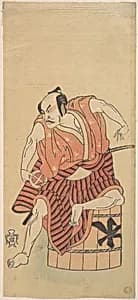
The Third Otani Hiroemon as an Otokodate Seated Upon an Inverted Tub
1768 or 1769
Medium
Woodblock print (nishiki-e); ink and color on paper
Dimensions
12 7/16 x 5 1/2 in. (31.6 x 14 cm)
Classification
Prints
Culture & Period
Japan · Edo period (1615–1868)
Department
Asian Art
Museum
Metropolitan Museum of Art, New York, NY
Credit
Purchase, Joseph Pulitzer Bequest, 1918
Accession Number
JP460
Rights
Public Domain
Tags
Art Historical Context
Katsukawa Shunshō's *The Third Otani Hiroemon as an Otokodate Seated Upon an Inverted Tub* (1768 or 1769) is a vibrant woodblock print from Japan's Edo period, capturing the swagger of kabuki actor Ōtani Hiroemon III in the role of an *otokodate*—a chivalrous street tough who defended the common folk against bullies. Perched confidently on an upturned wooden tub, Hiroemon embodies the larger-than-life heroism popular in urban theater culture, his dynamic pose and bold expression drawing viewers into the lively world of 18th-century Tokyo. As a master of the ukiyo-e ("pictures of the floating world") tradition, Shunshō helped pioneer actor portraits, or *yakusha-e*, that celebrated kabuki stars as cultural icons. This *nishiki-e* (brocade print)—a full-color woodblock technique using multiple carved blocks for intricate layering of pigments—marks an early triumph of multicolored printing, which brought affordable luxury to everyday audiences and elevated prints as high art. Housed in the Metropolitan Museum of Art, this intimate vertical *ōban* sheet (about 12½ x 5½ inches) reflects Edo Japan's booming print industry, where theater and visual storytelling intertwined, influencing global art from Whistler to van Gogh. A snapshot of fleeting fame and moral bravado, it invites us to ponder the enduring allure of performative identity.
About the Artist
Katsukawa Shunshō 勝川春章 (Japanese) · 1726 –1792
Japanese, 1726–1792