
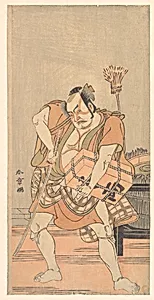
The Actor 2nd Nakamura Sukegoro as a Robber
Medium
Woodblock print (nishiki-e); ink and color on paper
Dimensions
H. 12 1/8 in. (30.8 cm); W. 5 7/8 in. (14.9 cm)
Classification
Prints
Culture & Period
Japan · Edo period (1615–1868)
Department
Asian Art
Museum
Metropolitan Museum of Art, New York, NY
Credit
Gift of Estate of Samuel Isham, 1914
Accession Number
JP896
Rights
Public Domain
Tags
Art Historical Context
In the vibrant world of Edo-period Japan (1615–1868), Katsukawa Shunshō's *The Actor 2nd Nakamura Sukegoro as a Robber* (1774) captures the dramatic flair of kabuki theater. This woodblock print (nishiki-e), or "brocade picture," showcases the renowned actor Nakamura Sukegoro II in a fierce robber role, complete with sword at the ready. Shunshō, a master of the Katsukawa school and pioneer of yakusha-e (actor portraits), expertly renders the performer's expressive pose and costume, blending realism with theatrical exaggeration to evoke the "floating world" of ukiyo-e entertainment. The nishiki-e technique revolutionized printmaking with its intricate layering of color blocks—up to 10 or more—allowing vivid inks to create lifelike textures on paper. Measuring just 12⅛ × 5⅞ inches, this intimate format made such prints affordable souvenirs for theatergoers, popularizing kabuki stars like Sukegoro among urban Edoites. Produced amid Japan's isolationist sakoku policy, these works preserved and democratized cultural icons. Today, housed in the Metropolitan Museum of Art, this print highlights Shunshō's influence on later ukiyo-e giants like Hokusai, offering a window into 18th-century Japan's passion for performance and artistry.
About the Artist
Katsukawa Shunshō 勝川春章 (Japanese) · 1726 –1792
Japanese, 1726–1792