
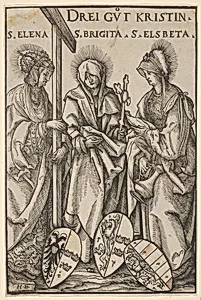
The Three Christian Heroines (Drei Gut Kristin), from Heroes and Heroines
Medium
Woodcut; first state of three (Hollstein)
Dimensions
Sheet: 8 1/8 × 5 3/16 in. (20.7 × 13.2 cm)
Classification
Prints
Department
Drawings and Prints
Museum
Metropolitan Museum of Art, New York, NY
Credit
Rogers Fund, 1918
Accession Number
18.20.2
Rights
Public Domain
Tags
Art Historical Context
Created around 1516 by the renowned German Renaissance artist Hans Burgkmair, in collaboration with master woodcutter Jost de Negker, *The Three Christian Heroines (Drei Gut Kristin)* is a striking woodcut from the series *Heroes and Heroines*. This first-state impression, measuring just over 8 by 5 inches, captures three saintly women—likely revered Christian figures—adorned with crosses and coats of arms, symbolizing faith, valor, and lineage. Burgkmair's design reflects the Northern Renaissance's blend of intricate detail and symbolic depth, while Negker's precise cutting brought the block to life. Woodcuts like this were revolutionary in the early 16th century, enabling affordable mass production of images that spread religious iconography across Europe. As one of Burgkmair's chiaroscuro-influenced prints (with states allowing for tonal variations), it showcases the era's technical innovation, where layered blocks mimicked painting's subtlety. Part of a broader series honoring legendary heroes, this piece underscores the cultural reverence for female Christian exemplars amid the Reformation's religious fervor. Housed in The Metropolitan Museum of Art's Drawings and Prints department (Rogers Fund, 1918), it invites visitors to ponder the power of printmaking in shaping devotion and identity during a transformative age.
About the Artist
Hans Burgkmair|Jost de Negker · 1473–1531
Hans Burgkmair the Elder (1473–1531) was a German painter and printmaker who became one of the leading artists of the Renaissance in Augsburg. Born into a family of painters — his father, Thoman Burgkmair, was a respected artist — he likely received his initial training in his father's workshop. He may also have studied with Martin Schongauer in Colmar, and a probable visit to Italy around 1507 ex...