
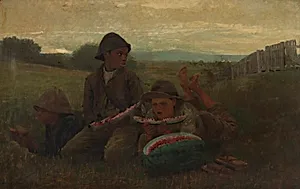
The Watermelon Boys
Medium
figures
Classification
figures
Department
Smithsonian Collection
Museum
Smithsonian American Art Museum
Credit
Gift of Charles Savage Homer, Jr.
Accession Number
1917-14-6
Rights
Public Domain
About this artwork
Research in Progress
Art Historical Context
Winslow Homer (1836–1910), a leading figure in American Realism, created *The Watermelon Boys* 1876, a time when the nation was rebuilding after the Civil War. Known for his vivid depictions of everyday American lifeoften featuring children, seascapes, and rural scenes—Homer captured the simple joys of youth in this work. The title evokes a summery, carefree moment, likely portraying young boys indulging in a slice of watermelon, a symbol of abundance and leisure in post-war America. Classified among the Smithsonian American Art Museum's collection of figures, this piece highlights Homer's mastery of watercolor techniques, though specifics are still under research. His loose, fluid brushwork and keen observation of light and texture brought a fresh vitality to genre scenes, influencing later American artists. Donated by Charles Savage Homer, Jr., it reflects family legacy in preserving Homer's contributions to capturing the nation's spirit. Homer's focus on ordinary moments elevated them to universal truths, making *The Watermelon Boys* a charming window into 19th-century innocence and resilience. Visitors will appreciate its timeless appeal in the Smithsonian's holdings.